
Why Grief Doesn't Get Easier
Grief doesn't get easier. You get bigger.
I am working with a client who’s mum died in March this year. Recently, well-meaning people keep telling her the same thing, “It will get easier”. Family said it. Colleagues said it. The problem though, it wasn't getting easier. It was getting harder.
She sat in front of me describing thoughts that wouldn't switch off, a body that ached in ways she couldn't explain, and a craving, that's the only word she had for it, to be near anything that still smelled or sounded or felt like her mum. Meanwhile she still had to go to work. She still had to be a sister, a partner, a colleague who showed up on time and didn't cry in the wrong meeting. Everyone around her was waiting for the ‘easier’ to arrive. She was starting to wonder if something was wrong with her because it wasn't. I explained that there is nothing was wrong with her. The advice was wrong.
‘It gets easier’ is one of those phrases that sounds kind and lands like a slap. It quietly tells a grieving person that their current pain is a fault to be corrected, a stage to be passed through on the way to a calmer, tidier version of themselves. When that doesn't happen on schedule, grief stops being something a person is living through and starts being something they think they're failing at.
Julia Samuel, who has spent decades sitting with bereaved families, describes grief not as a problem with a fix but as a paradox to be lived inside. She's written about grief as something we don't move through in neat phases and don't simply forget our way out of. It's an individual process with its own momentum, and the real work is learning to bear the pain while adjusting to who we are now. Pain, in her framing, isn't the enemy. It's the mechanism. It's how we come to terms with a reality we didn't choose. That's a very different promise to ‘it gets easier’. It's not a promise of comfort. It's a promise of change.
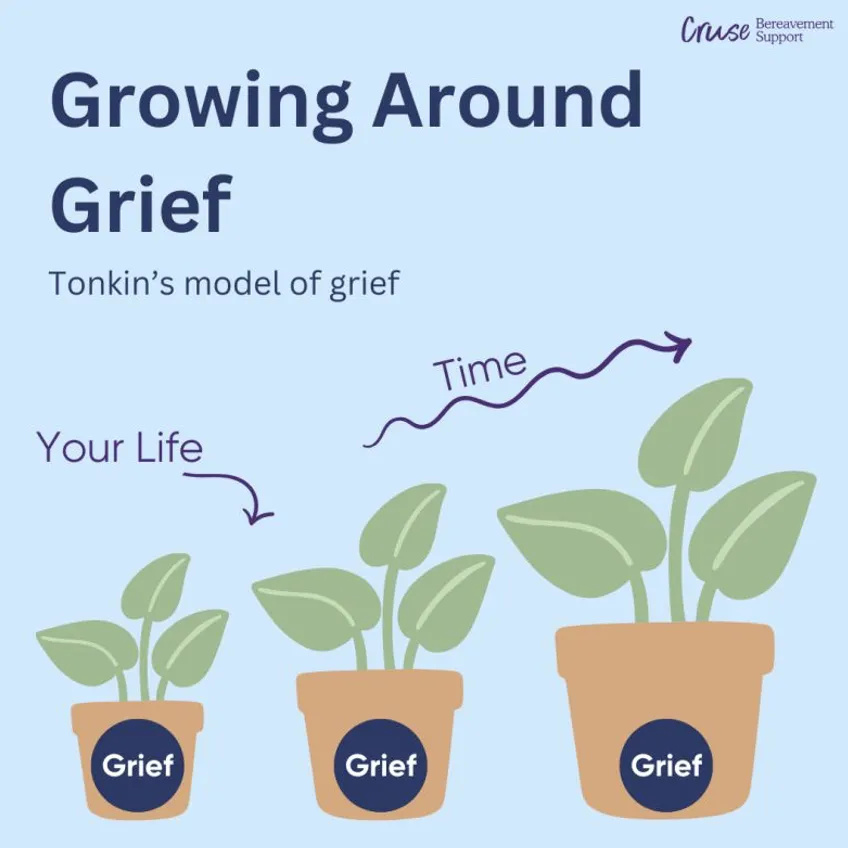
The bereavement researcher Lois Tonkin gave us a better model than the ‘stages’ most of us were taught. She'd spent years listening to people who were clearly moving forward with their lives while still carrying grief as intensely as the day it began, and it didn't fit the idea that grief was supposed to shrink over time. So she drew it differently, with a circle. At first, grief fills the whole thing, every waking hour, every thought. The instinct is to expect that circle of grief to get smaller as time passes. Tonkin found the opposite happens. The grief itself doesn't really shrink. The person grows. New relationships, new roles, new capacity for joy build up around the grief rather than replacing it, until eventually there's simply more life surrounding the same-sized loss. When describing this to my client, we imagined grief being a plant pot, always there, always present. The plant is the person, the individual growing and learning how to survive with the grief forever present. Some days she can give herself the optimum conditions to grow, other days she can’t. Some days she is standing upright, bright and wonderous, other days she feels like she is wilting, feeling flat and immobile.
Some days that loss still fills the whole frame. A smell, the sight of a robin, a yellow butterfly, and my client’s back at the centre of the circle or exactly where she started. That's not regression. That's not ‘not getting easier’, that's grief filling the circle again, exactly as it's supposed to.
It's worth remembering that grief isn't a malfunction. It's not a design flaw in the human nervous system that we need to engineer our way out of. We evolved the capacity to love deeply, and grief is simply the tax on that. Elephants stand over the bones of their dead. They return to the same sites years later. They go quiet, they touch the remains, they seem to mourn. We are not the only species that has worked out that loving something means eventually losing it, and that the losing leaves a mark.
If elephants don't rush their dead to a tidy resolution, why do we expect it of ourselves?
I don't tell my clients grief will get easier, because for most of them, in the early and middle months, it simply isn't true, and telling someone their lived experience is wrong is not therapy. It's abandonment dressed up as reassurance.
What I say instead is “you are not shrinking your grief. You are growing a life that can hold it”. Some weeks that life will feel enormous and the grief will feel small in comparison. Some weeks it'll be the reverse. Neither is a verdict on how well they are doing.
My client didn't need her grief to get smaller. She needed permission to stop measuring herself against a timeline nobody had actually agreed to. Once that pressure lifted, she wasn't in less pain but she was no longer at war with herself on top of it. That's not nothing. That's most of the work.
Grief doesn't get easier. You get bigger. And that's a far more honest thing to promise someone standing at the start of it.
Sources referenced: Julia Samuel, Grief Works: Stories of Life, Death and Surviving; Lois Tonkin's "growing around grief" model (1996).